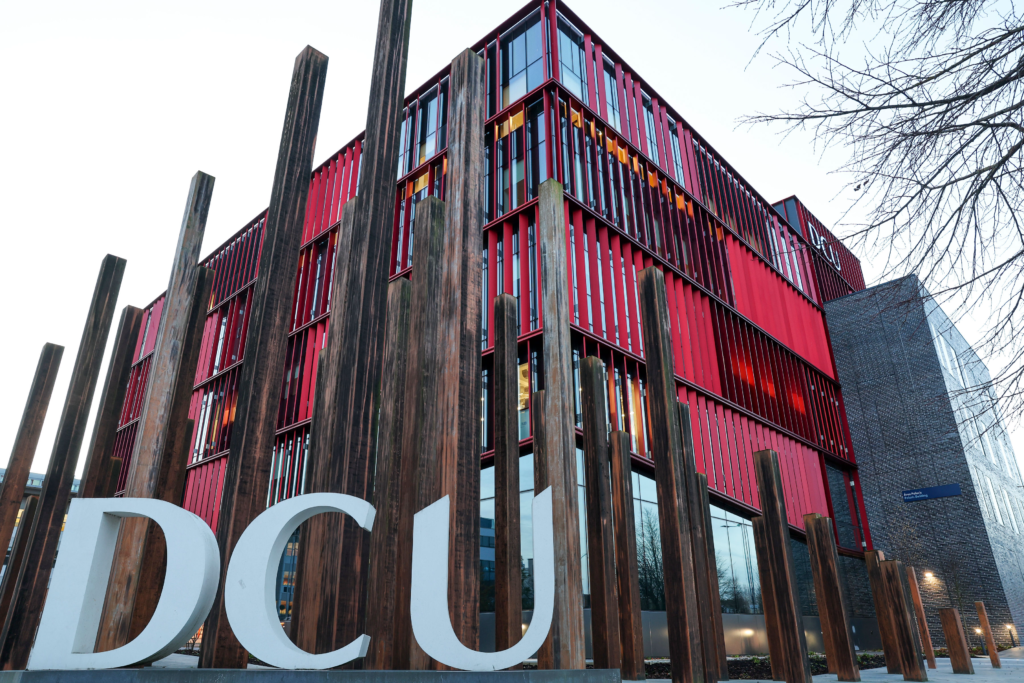
Dublin City University
Dublin City University (DCU) is a diverse university that has always described itself as a university of access and inclusion. Founded in 1980 with a mission to open higher education to those who might not otherwise have had the opportunity, that commitment runs deep in DCU’s DNA to this day.
“Inclusion is one of our key core values, and the idea of reducing barriers and opening up opportunities for learners is central to everything we do.” Rob Lowney, Dublin City University.
Digital accessibility, web accessibility, and content accessibility are a natural and important part of that commitment. Over recent years, we have been on a journey to actively support and encourage our lecturers to embed accessibility into their teaching practice.
About ten years ago, Universal Design for Learning (UDL) caught our attention as a framework that could make a real difference. UDL became a great way for us to promote accessibility and inclusion, and to reduce barriers, in a manner that lecturers could relate to and understand. Rather than feeling compliance-heavy or onerous, it opened up possibilities. Our colleague at the time, Dr Suzanne Stone, led the development of UDL templates for Moodle, supported by resources and professional development for staff around putting UDL into practice.
As we moved towards more actionable and specific steps, one important tool we had on our Moodle site was an accessibility block. This allowed users to personalise their Moodle course interface by applying a colour overlay, changing the font, and more. It also incorporated an assistive technology bar with text-to-speech functionality, allowing the page to be read aloud.
Over time, that plugin was no longer actively maintained, which was a concern given how central it was to our UDL templates. We had included the accessibility block on all Moodle courses using the template, so keeping it functional was a priority. Knowing we needed a more sustainable solution, we reached out to Brickfield Education Labs.
Challenges
We were progressing along our UDL journey, promoting better inclusion practices, and remaining conscious of our obligations under disability legislation.
We do have students with significant disabilities, including those who are partially or fully blind, or partially or fully deaf. My sense is that many of those students would previously have had to approach each lecturer individually to request alternative versions of their learning materials. The content conversion feature within Brickfield’s Accessibility Toolkit has changed that dynamic entirely. Students no longer need to seek out alternative formats. They have full control over converting their learning materials into whatever format suits them best.
While we do not have data to compare before and after, what we can say with confidence is that the partnership with Brickfield Education Labs has helped us advance our UDL journey.
Solution
Restoring the Moodle Accessibility Block
We reached out to Brickfield. Through funding from DCU’s Disability Learning Support Service, we commissioned Brickfield to update the accessibility block once. That was a key milestone for us, and it was the beginning of what has grown into a much broader partnership around accessibility. This work took place around six years ago.
Piloting and Adopting the Brickfield Accessibility Toolkit
Around the same time, Brickfield were developing the Accessibility Toolkit, and DCU was involved from the very beginning. Our colleague at the time Mark Glynn worked closely with Gavin and Karen at Brickfield during the ideation, prototyping, and trialling process, bringing the lecturer’s perspective into the design.
We organised lecturers to trial the Toolkit and provide initial feedback, which fed directly into the first enterprise release. It was a privilege for DCU to have had a hand in shaping the product.
The Toolkit is very user-friendly, which I think reflects the fact that it was designed with lecturers in mind from the outset. It allows staff to quickly and easily analyse and address accessibility issues in their course content. We have had the Toolkit installed for about five years now and have continued to take advantage of new features and releases as they have become available.
The Brickfield Guides are wonderful and have been a great addition. We have included them in the Moodle menu bar and added a second link on all course pages as part of our updated UDL templates, ensuring they are easy to find and access. We have also implemented single sign-on (SSO) for the Brickfield Accessibility Training, reducing friction for staff engaging with professional development.
Brickfield Academy Training for the Web Team
About four years ago, we introduced Brickfield Academy training for our web team, who are responsible for the DCU website. They were very conscious of their obligations under the disability legislation to make sure that the public sector website was accessible and readable. So, they began a journey of promoting and making sure all of the website editors knew how to create accessible web pages. We reached out to Brickfield to provide that training. The web team was very happy with the quality of the courses.
“The training through Brickfield Academy was just absolutely perfect. It provided the basics, it was easy to access, easy to use, it was not too onerous. It gave the website editors exactly what they needed to start creating accessible content with confidence.” Rob Lowney, Dublin City University.
Outcomes
The partnership with Brickfield has helped us advance our accessibility journey and meet our obligations under disability regulations, while providing tools that are simple and easy for both students and staff to use.
Our web team are improving the accessibility of the DCU website, and that is in large part down to the foundational training they received through Brickfield Academy.
The benefits extend well beyond students with disabilities. There is now much greater choice. Any student can convert a PDF into an audio file for example. If they want to adjust how they interact with Moodle, learn how to make accessible documents, or learn to use their browser more effectively, they can do that too. The great thing about the Toolkit is that it is for everyone: all teachers and all learners, not just those with specific assistive needs.
The reaction from lecturers who engage with the Toolkit for the first time is consistently enthusiastic. Once they see how straightforward it is to identify and resolve accessibility issues in their course content, the response is invariably: ‘Oh my God, this is amazing. Why isn’t everyone doing this?’.
There is also a cross-fertilisation effect across other tools and systems. As staff become more attuned to accessibility issues in Moodle, it shifts their thinking more broadly. They are more likely to run accessibility checkers in Microsoft Word or PowerPoint as well. The impact extends well beyond what they do in Moodle and is helping to move staff and lecturers towards being more accessibility-aware across everything they produce.
Many of our students commute to Dublin and spend that time studying on their phones, often reading or reviewing notes. Being able to access learning content in different formats, whether through text-to-speech, speech-to-text, or other built-in device features, gives those students more choice and more opportunity.
“That is what accessibility and universal design is fundamentally about: increasing flexibility and choice through providing more ways to engage with learning.” Rob Lowney, Dublin City University.
There is real potential here to embed a genuine culture of accessibility across both staff and students, and that is something DCU is actively working towards.
Students are engaging with technology in increasingly fluid and varied ways. Our Moodle statistics show they access the platform from computers and phones, on the go, and from locations around the world. Developing digital skills is a key priority at DCU as part of our transversal skills framework, and we are seeing growing numbers of assignments that require students to create their own digital artefacts, from presentations and documents to videos. Having the Brickfield Guides available to support them in creating accessible content will be increasingly valuable. If we are developing students’ digital skills, we need to ensure that accessibility is built into that process from the start.
Future Plans
The ongoing priority is to continue promoting the Toolkit and encouraging more staff to engage with it. Once a lecturer uses the Toolkit and sees how easy it is to analyse and fix errors on a course, the reaction is always one of amazement at how straightforward it is. After five years, the momentum is there, but the work of bringing more and more lecturers on board never really stops.
What really excites me about Brickfield Enable, the new release of the Accessibility Toolkit, is the Brickfield TinyMCE checker, an accessibility checker built directly into the text editor. It performs 90+ checks as content is being created and edited. The ability to identify and resolve issues before content is ever published is genuinely transformative.
“Brickfield Enable means accessibility and inclusion are being practised from the very outset, preventing poor practice rather than remediating it after the fact.” Rob Lowney, Dublin City University.
For DCU, this has the potential to be a real game changer.
Reccomendations
Ensuring that lecturers understand the purpose behind what they are doing is essential. The Toolkit, and accessibility initiatives more broadly, should not be approached primarily as a compliance exercise. There is a compliance element, of course, and institutions must ensure their materials, web services, and VLEs are accessible. But the motivation needs to go well beyond that.
It is important for staff to hear directly from learners who benefit from accessible content. Many lecturers will not know which of their students have learning needs or disabilities, and some of those students may not have a formally recognised disability at all. They may simply find certain methods or tools make it easier to engage with material.
When introducing the Toolkit, keep the focus on the why and the who. Why is this being done, and who does it impact?
“Hearing from students who benefit from accessible content is hugely important because it makes the purpose tangible.”Rob Lowney, Dublin City University.
Staff should not feel they are simply fixing errors and HTML tags in isolation. At the other side of every screen is a person, a learner, whose experience is directly improved, and barriers are removed when the Toolkit is used. For institutions beginning this journey, the most important principle is to keep people at the centre. The work exists to improve outcomes for learners, and that should remain the driving motivation throughout.
The partnership we have with Brickfield is at the heart of how they support us, and that matters enormously. When working with another organisation, a shared set of values is a genuine foundation for success. DCU has benefited enormously from working with Brickfield, and is eager to continue that partnership, grounded as it is in a shared commitment to inclusion and to improving learning for students. The relationship is much more than a vendor-client arrangement. There is ongoing dialogue and mutual learning on both sides. Brickfield makes DCU better, and I like to think DCU helps make Brickfield better too. It is not simply a matter of using a product. It is a genuine, collaborative partnership built on shared values.