AI in Action: Insights from MoodleMoot Global 2025
Earlier this month, MoodleMoot Global 2025 brought the international Moodle community together in Edinburgh, Scotland, for three days of collaboration, innovation, and future-focused ideas. It was a vibrant showcase of how the Moodle community continues to evolve.
From product updates to inspiring keynotes, one theme stood out: Artificial Intelligence (AI) is transforming how we teach, learn, and design for the future. By the final day, it was clear that AI was not just a passing trend; it was one of the most discussed, debated, and inspiring topics of MoodleMoot Global 2025. Sessions explored how AI can empower educators, engage students, and streamline course design – all whilst keeping ethics, empathy, and trust at the core of innovation.
Table of Contents

Designing for Connection, Not Automation
AI can often feel impersonal, a layer of technology between people and their learning. This year’s MoodleMoot flipped that narrative. Across multiple sessions, speakers demonstrated how AI can enhance connection, not diminish it.
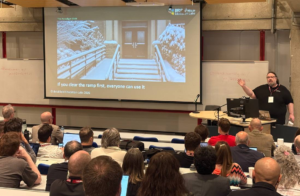
Jean-François (Jeff) Van de Poël’s session captured this perfectly. He showed how AI-powered tools can turn a large lecture into a responsive, interactive experience. From adaptive prompts to live polls that adjust in real time, his demonstrations illustrated how AI helps educators respond dynamically to learners, scaling engagement that would otherwise be impossible for one teacher to manage alone. Watch his full presentation.
In similar spirit, Fred Dixon, CEO of Blindside Networks (creators of Big Blue Button), explored how AI and analytics are re-shaping virtual classrooms. In his talk, “The future of virtual classrooms built on pedagogy, AI, and analytics”, Fred emphasised that online learning must move beyond passive video calls. He argued that virtual classrooms should be built on pedagogy first – leveraging AI to support active learning through engagement metrics, polls, and real-time feedback loops. His vision was not about replacing teachers with technology but about giving them better visibility into how students are learning, moment by moment.
Building Inclusion Through Intelligent Design
Inclusion and equity were recurring touchpoints throughout the conference, with Amy Tessitore’s talk, “Leveraging AI to create inclusive and equitable learning experiences”, standing out as one of the most thought-provoking contributions to this conversation.
Amy highlighted how AI can be used not just to personalise learning, but to level the playing field. She demonstrated how AI-powered tools can detect accessibility gaps early in course creation, recommend inclusive design choices, and even surface potential bias in learning materials. Rather than treating accessibility as an afterthought, she encouraged educators to view AI as a partner in creating fair, equitable learning environments.
She also spoke about the ethical dimensions of AI – reminding the audience that inclusion requires not only diverse datasets and transparent algorithms, but also educators who are conscious of whose voices are reflected in the data. Her message was clear: AI has the potential to support every learner, but only if we build systems that are transparent, fair, and rooted in empathy.
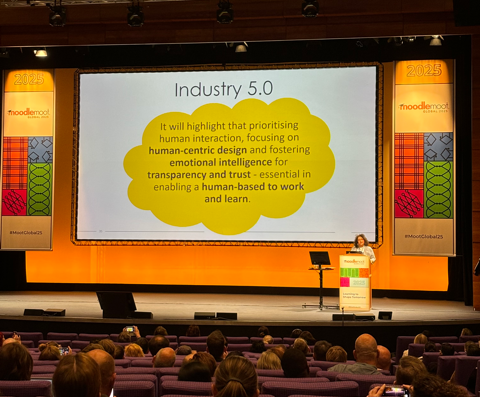
This theme connected powerfully with Dr. Neema Pasha’s keynote, which described industry 5.0 as a new era of human-machine collaboration. Rather than chasing efficiency, she urged educators to use AI to cultivate creativity, empathy, and to design for human flourishing, not just automation. You can watch her full presentation on YouTube.
Creativity and Co-Creation in Course Design
Many sessions highlighted AI’s creative potential, showcasing how it can support as a collaborator that helps generate ideas, prototypes, and new learning experiences.
Javier Tejera from The University of Edinburgh presented an inspiring example of this, showing how generative AI can help bring imaginative teaching concepts to life. Their prototypes ranged from simulated stakeholder interviews to immersive clinical case scenarios in healthcare education – all designed to push learners to think critically, apply theory, and make decisions supported by AI feedback.
Platforms like Dixeo also demonstrate what’s possible when AI supports course creators directly. Using generative tools, Dixeo can automatically build structured Moodle courses – complete with activities, quizzes, and resources – and even includes an AI tutor that supports learners in multiple languages. Rather than replacing human creativity, these tools amplify it, helping educators spend more time refining ideas and connecting with students.
Ethical AI and the Future of Human-Centred Learning
By the end of MoodleMoot Global 2025, one message resonated across sessions and speakers: AI’s true potential in education lies not in automation, but in elevation.
DR. Neema Pasha urged in her keynote, that the future of learning design must be purpose-driven and ethical, ensuring that technology reflects our values rather than reshaping them. Educators must continue asking essential questions:
- Whose voices are represented in the data.
- Are AI systems transparent and fair?
- Are we using technology to create opportunity and belonging – or to reinforce barriers?
AI in education is not about replacing teachers – it is about empowering them to be more creative, more responsive, and more human than ever before.
Final Reflection
AI is no longer a futuristic concept – it is an active collaborator in shaping the next era of learning. When grounded in empathy, ethics, and evidence-based pedagogy, it has the power to turn classrooms (both physically and virtual) into more inclusive, engaging, and inspiring places to learn.