MoodleMoot Global 2025 - Edinburgh!
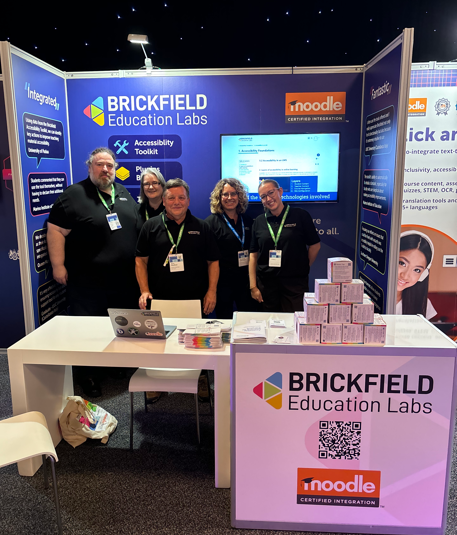
Earlier this month, we were delighted to join MoodleMoot Global 2025 in Edinburgh, Scotland, as a Gold Sponsor. The event brought together more than 740 attendees from fifty-nine countries, alongside ninety-nine presenters from twenty-three nations, for three days filled with ideas, innovation, and community. This year’s MoodleMoot carried a clear message: learning shapes tomorrow. By making learning more accessible, inclusive, and adaptable, we can build a brighter future for everyone.
Table of Contents

Day 1: Setting the Stage
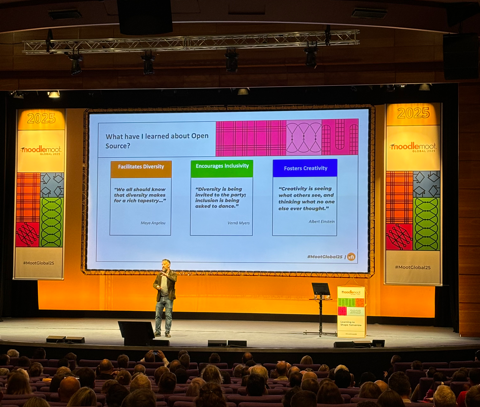
The Moot opened with a keynote from Scott Anderberg (Moodle CEO), who reminded us that learning is not just about outcomes, but about the process of building the future together. He stressed that Open Source sits at the heart of this journey. Its flexibility, cost-effectiveness, and community collaboration enable the diversity and creativity that allow learning to flourish.
Scott also shared that one of the highlights of his role is witnessing the creativity of Moodle’s global community, whether that is through the creative use of existing tools or the development of entirely new ones. His keynote set the tone for three days of optimistic, forward-thinking discussions, inspiring us all to help shape tomorrow’s learning today. Watch Scott’s full presentation.
Accessibility in Focus
Accessibility emerged as a strong theme from the start.
Jarno from ReadSpeaker delivered a powerful session on accessibility legislation world-wide, from the EU Accessibility Act to the ADA. He introduced a 5-step road map for compliance and inclusion:
- Assessing needs.
- Adapting universal design.
- Training staff.
- Evaluating progress.
- Fostering inclusive culture.
His message was clear, accessibility is not just a legal requirement, it drives better outcomes, from improved retention to stronger institutional reputation. Watch Jarno’s full presentation.
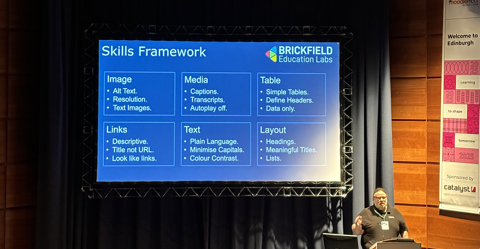
Later, Gavin Henrick (Co-Founder of Brickfield Education Labs) expanded the conversation from compliance to confidence. His session introduced the 18-point Accessibility Skills Framework, a practical guide spanning text, images, media, layouts, and more. The framework helps educators and learners build everyday skills that make content flexible and usable. You can download our Accessibility Tips printable zine, and order the Accessibility Tip cubes online. You can find out more about Gavin’s presentation on our blog or watch his full presentation.
Beyond accessibility, the first day also highlighted Moodle’s versatility across sectors:
- Higher education – tackling challenges such as large-scale assessment, student retention, and reducing administrative workload.
- Workplace learning – using Moodle to deliver apprenticeship training and automated compliance learning.
- Teaching and course design – practical strategies for reducing learner fatigue, boosting engagement, and streamlining course creation.
Day 2: Innovation and Digital Freedom
The second day opened with a focus on Moodle’s future direction, led by Moodle HQ.
- Marie Achour highlighted the evolution of the Moodle product team, sharing the shift toward impact-driven development, user-centred design, and technical excellence. The goal? Prioritising features that matter most to its diverse community members, ensuring the platform remains not only powerful but also enjoyable to use and easy to extend. Watch her full presentaiton.
- Setara Singh introduced the upcoming Moodle Marketplace, a new platform designed to connect developers, service providers, and users. Setara explained how the marketplace will improve plugin discovery, evaluation, and adoption whilst also offering support for plugin creators. Watch her full presentation.
Digital Freedom and Capital
Two standout sessions explored what learners need to truly thrive in digital spaces.
Gavin Henrick’s (Co-Founder of Brickfield Education Labs) session opened on a high note, quite literally, with a revised version of the song “I’m Gonna Be (500 Miles)” by The Proclaimers, reimagined around accessibility. It was a brilliant icebreaker that had the whole room singing along and you can watch the video to relive the moment!
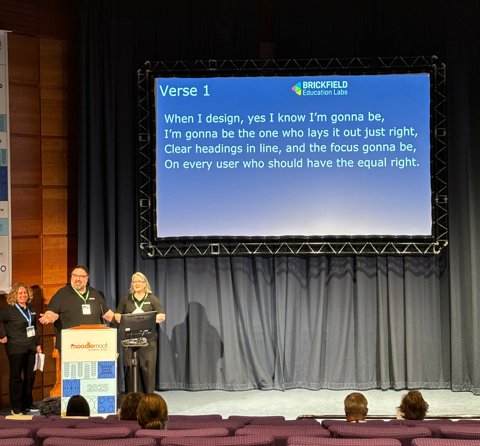
Gavin then spoke about digital freedom, reminding us that true digital freedom is not just having access to content, but knowing how to shape it to meet personal needs.
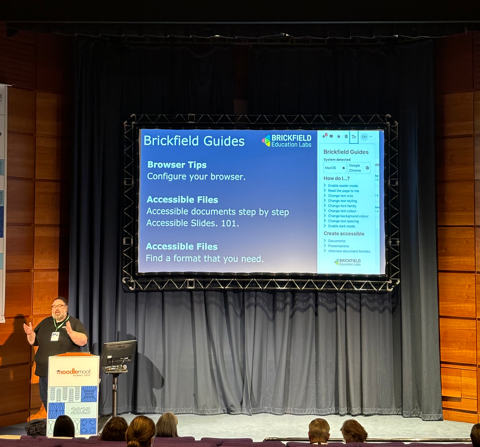
Brickfield Guides
Using the Brickfield Guides, he shared practical ways in which learners can personalise their digital environments, including how to:
- Enable reader mode.
- Change text size, styling, font, and colour.
- Change text spacing.
- Change background colour.
- Enable dark mode.
And how to create accessible:
- Documents.
- Presentations.
- Alternate document formats.
The message was clear, when learners have the freedom to adopt digital content to their needs, everyone benefits. You can find out more about Gavin’s presentation on our blog or watch his full presentation.
Building on this theme, Liz Starbuck Greer explored the idea of digital capital: the skills, confidence, and awareness learners need to thrive online. She highlighted how not all learners come with the same level of access or confidence.
Those with high digital capital:
- Multiple devices.
- Strong internet connection.
- Supportive networks.
While those with lower digital capital may face barriers that impact their ability to participate fully, such as:
- Limited devices.
- Limited support.
Together, these sessions underscored a powerful point: accessibility and equity go hand in hand. Digital freedom provides the tools to personalise learning, whilst digital capital reflects the confidence and resources learners bring with them.
As educators and designers, our role is to create courses that are not only clear and consistent but also flexible and inclusive – so that every learner, regardless of their starting point, can engage, belong, and succeed.
Other Interesting Presentations
Many other presentations stood out for the way they highlighted Moodle’s evolving role in education and training.
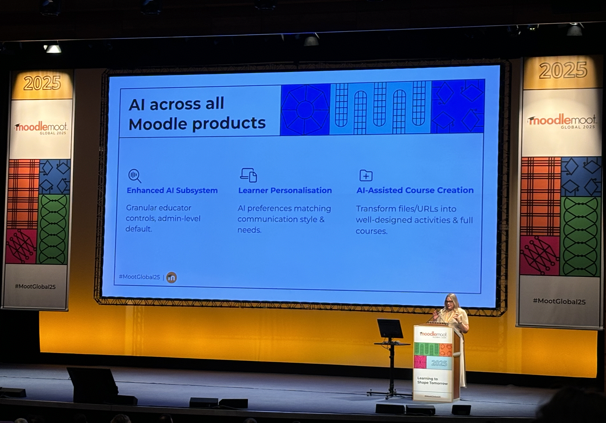
- Artificial Intelligence (AI) was a recurring theme, framed not as a replacement for teachers but as a tool to enhance pedagogy, efficiency, and inclusion. Read more about AI at MoodleMoot Global.
- Moodle Workplace appeared in many presentations demonstrating how it can deliver structured apprenticeship pathways whilst also meeting compliance and reporting requirements, highlighting Moodle’s strength in vocational and professional training.
- A highlight came from Ugo Carus, Sofia Exarchou & Kenny McCormack, who shared “Scaling learning: The UN’s Moodle Workplace story.” Their session explored how Moodle supports global training in high stakes environments: delivering consistency, ensuring reporting accuracy, and adapting to diverse regional contexts. It was a powerful reminder of Moodle’s capacity to operate at massive scale while maintaining reliability and inclusivity. Watch the full presentation.
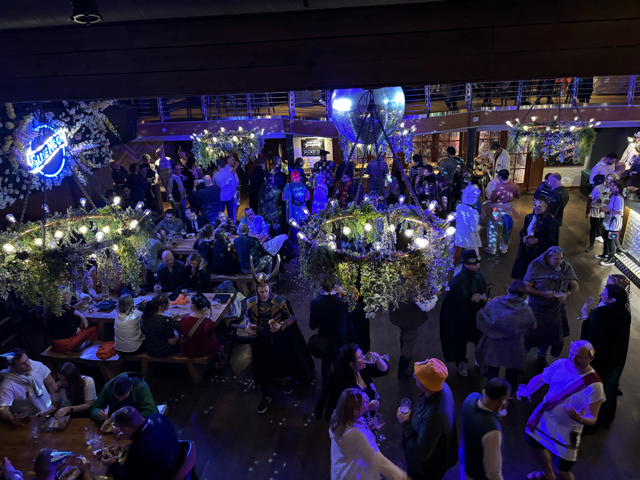
The day wrapped up with a lively themed costume party, giving a chance for everyone to celebrate together!
Day 3: Looking Ahead
The final day of MoodleMoot Global 2025 opened with an inspiring keynote by Dr Neema Pasha on Industry 5.0, looking ahead to the future of learning and Moodle’s evolving role. Her talk emphasised the balance of human intelligence and AI, with technology as a partner, not a replacement. She stressed that AI in education should serve not just efficiency, but also personalisation, inclusivity, and sustainability. The message was clear, the future of work and learning depends on emotional intelligence, ethical leadership, and continuous growth, with technology acting as a partner rather than a replacement. Watch her full presentation.
Empowering People Through Better Learning Design
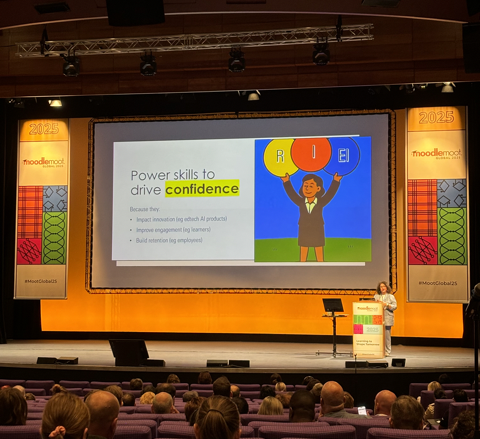
A reoccurring theme in day three was empowerment through learning design. Whether it was educators, learners, or course designers and trainers, these sessions showed how Moodle can strengthen skills, confidence, and outcomes when used thoughtfully.
- University of the West Indies, Mona shared how the COTT initiative empowered faculty through peer-led training and workshops. By fostering collaboration and building confidence, they turned Moodle adoption from a post-pandemic necessity into a sustainable culture of innovation.
- Mareike Scheffe presented a vocational case study from Germany, where Moodle became the sole training platform for apprentices in ophthalmology clinics. Gamification and interactive plugins not only improved grades but also empowered learners to feel work-ready sooner, reducing admin and travel for staff. Watch the full presentation.
- Nadia Perujo asked the timely question: “May I have your attention please?” Her session explored how to design courses that cut through distraction. By applying strategies like storytelling, retrieval practice, and spaced repetition, educators can empower learners to retain knowledge and engage more deeply.
Together, these sessions illustrated that empowerment in learning comes from designing environments where people feel confident, engaged, and prepared, whether they are teachers, students, or professionals in training.
Final Reflection
MoodleMoot Global 2025 proved that the future of learning rests on accessibility, innovation, and community. The sessions and stories were not just inspiring — they offered real tangible steps we can take to shape tomorrow’s learning, today.
A huge thank you to the organisers, speakers, and the entire Moodle community for making this event such a powerful space for connection and growth.