Do You See Me? Turning Accessibility Awareness into Action
Learning Disability Week (15–21 June) is a moment to pause and reflect on an important question: Who are we designing for — and who might still be left out?
Led by Mencap, this UK-wide initiative is dedicated to making sure the world hears what life is really like for people with a learning disability. The 2026 theme, “Do You See Me?”, is a powerful call to action — created by people with a learning disability themselves — to ensure they are truly seen, heard, included, and valued.
In England alone, around 1.3 million people live with a learning disability. It affects how someone takes in, understands, and uses information. It is lifelong, varies from person to person, and has nothing to do with intelligence.
Education is one of the clearest routes out of exclusion. It’s also one of the easiest places to accidentally build a wall.
Being seen only matters if it changes how things get built. In practice, that means:
- Better everyday design decisions.
- Clearer priorities and frameworks.
- A focus on learner independence.
- Continuous reflection and improvement.
Accessibility Lives in Everyday Design Decisions
When we talk about inclusion, especially in education and digital learning, accessibility is often where it either succeeds — or fails.
Accessibility is often thought of as complex or technical. But in reality, it shows up in small, everyday choices.
Things like:
- Missing image descriptions.
- Videos without captions or transcripts.
- Non-descriptive links.
- Dense, complex language.
- Poor structure and formatting.
These decisions add friction. And for some learners, that friction becomes a barrier. Collectively, they shape whether content is usable — or not.
And importantly, these barriers are not inevitable. They are design decisions. We’ve written about several of them individually:
- When Captions Become Decoration.
- Transcripts Are Not a Nice-to-Have. They Are the Session.
- Opening Links in a New Window: Accessibility Guidance.
- Why ALL CAPS Text Creates Reading Barriers.
- Accessible Document Formats.
When those decisions are made well, the benefits extend far beyond a single group of users:
- Clearer language helps people who are busy, stressed, or reading in a second language.
- Transcripts help people revisit content and learn at their own pace.
- Structured content makes it easier for anyone to follow.
This is why accessibility is not just about inclusion. It’s about quality.
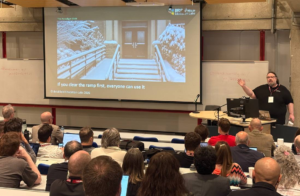
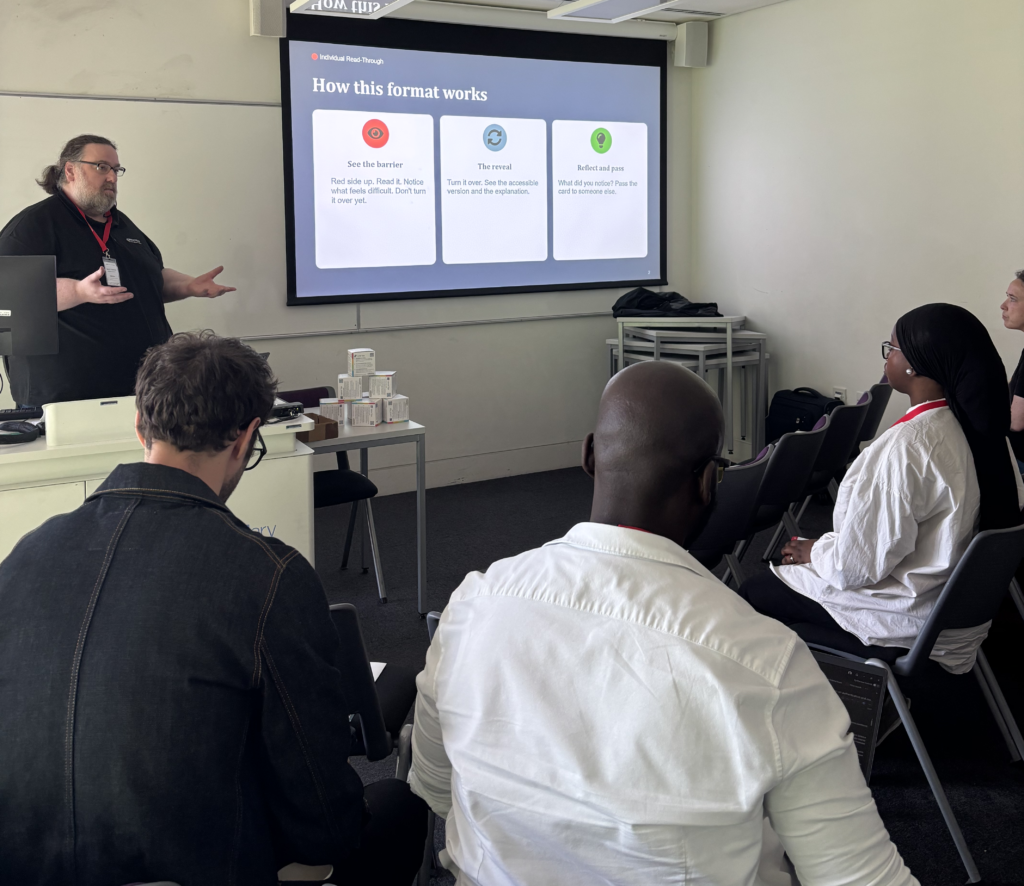
Last week, we saw exactly how this plays out in practice at the Catalyst Moodle Community Day, at Queen Mary University of London.
Community events like this matter. They move accessibility beyond theory and into shared experience.
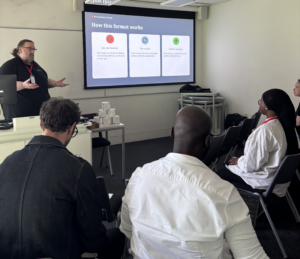
One of the most impactful moments came from our empathy workshop. Gavin Henrick (CEO and co-founder of Brickfield Education Labs) built the session around a simple mechanic: a set of cards, each showing a barrier on one side and the accessible version on the other side.
Participants experienced the friction first. Difficulty reading. Slower comprehension. A real emotional response.
Then they flipped the card. Same content — but accessible. The reaction was immediate.
What stood out most was this: people who didn’t identify as having a disability still felt the impact. It reinforces an important truth: most accessibility barriers affect far more people than we expect. They affect everyone.
We’ve collected the everyday fixes for problems exactly like these into one place — short, practical, and built for anyone creating content, not just accessibility specialists.
Browse Brickfield’s Accessibility Tips
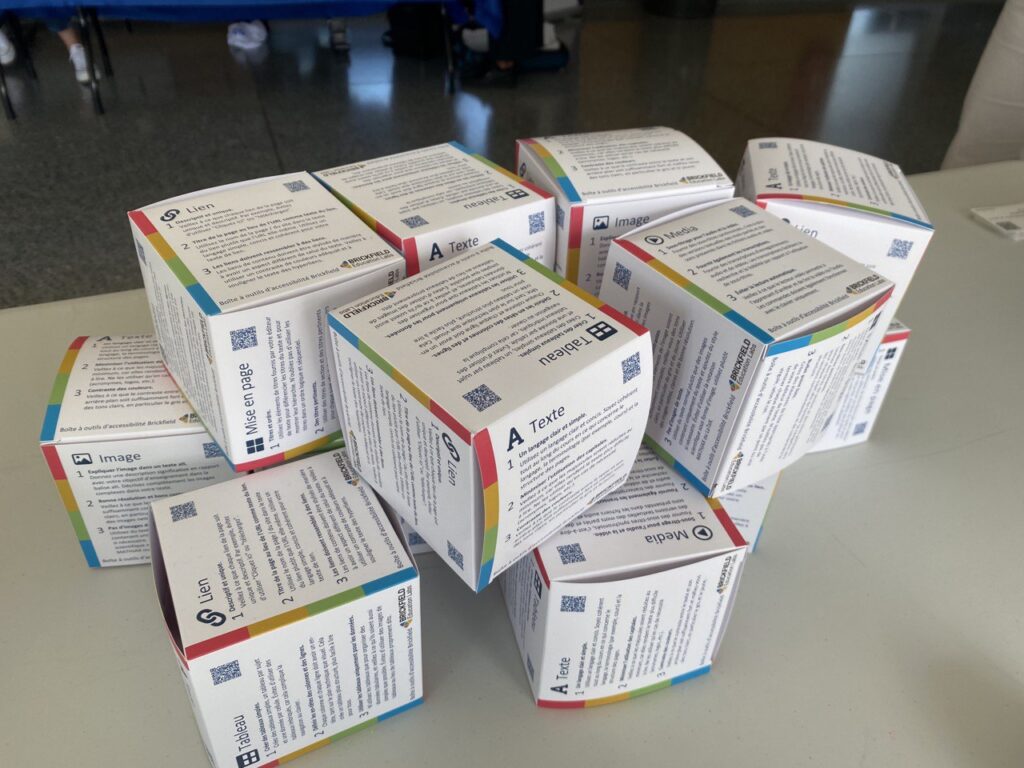
We’ve turned these everyday fixes into something tangible. Our accessibility tip cubes are small, desk-based prompts with practical tips on every side — a quick reference that keeps accessibility visible and actionable.
The Hierarchy of Effective Learning Content
Noticing the barrier is the start. Knowing what to fix first is the next step.
Because accessibility work can quickly feel overwhelming.
The Hierarchy of Effective Learning Content addresses this by introducing a simple idea, accessibility is a sequence, not a checklist.
- Availability — can the content be accessed at all?
- Accessibility — can it be used without barriers?
- Usability & clarity — is it easy to understand?
- Enhanced learning — does it support deeper engagement?
When built in the right sequence, each level strengthens the next.
Most institutions reach straight for Universal Design for Learning and wonder why it doesn’t stick. UDL is the right aspiration — but it’s the top of a five-level structure, not a starting point. Underneath it sit four foundations that have to hold first.
We’ve written the full framework, with the data behind each level and what to do about it.
Read: The Hierarchy of Effective Learning Content: From Available to Universal
Looking Ahead: Continuing the Conversation
Moments like Learning Disability Week are important because they bring visibility and focus.
Across the sector, that conversation continues through shared spaces — including events like Digital Accessibility 26, a free, distributed conference on digital accessibility. Hosted virtually by the University of Nottingham next week (24th June 2026), it brings together lived experience, practical solutions, and institutional strategy in one programme.
You can join online, or through a local hub if your institution is running one.
Turning “Do You See Me?” Into Action
“Do You See Me?” is a powerful question.
But the real challenge is what comes next. Because being seen is not just about recognition. It is about ensuring systems, content, and experiences are designed to work for everyone.
At Brickfield, that is where we focus our work — helping institutions move from awareness to practical, scalable change.
Because accessibility is not something you finish. It is something you build, step by step.