Skip to content
Home » Archives for Annabelle Snow

Annabelle Snow

Who needs transcripts? Online Training & Accessibility.

Transcripts Are Not a Nice-to-Have. They Are the Session.
  • 11 min read

Online training without a transcript is not fully accessible — it never was. When a session ends with no written record, it quietly excludes a significant proportion of learners: people who are Deaf or hard of hearing, those with auditory processing differences, ADHD, working memory difficulties, non-native speakers, and many others. Most of these needs are invisible to a facilitator; participants won’t announce them, they’ll simply get less from the session — or not attend at all. Transcripts aren’t a special accommodation. They’re part of how good training works.

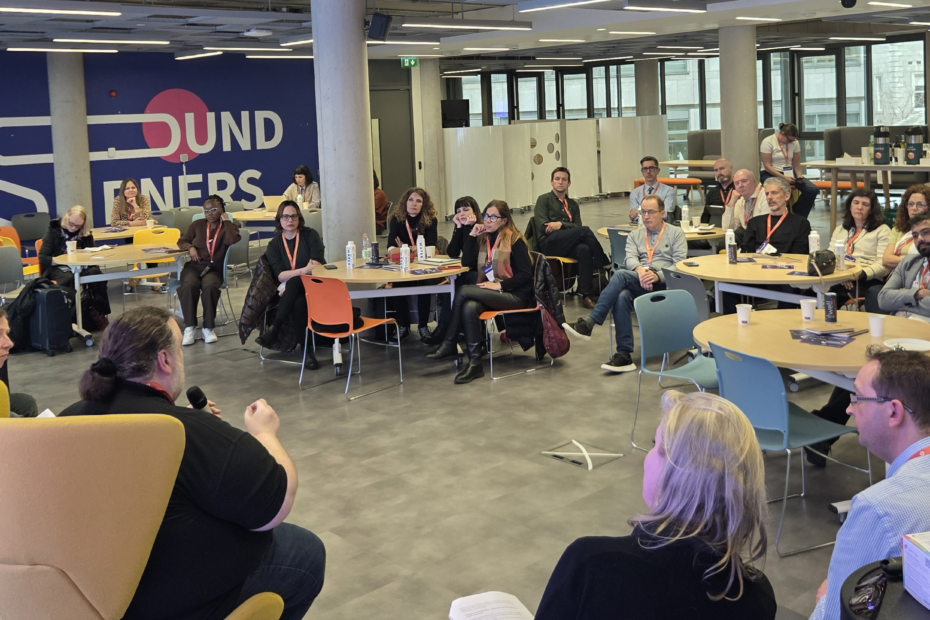
Attendees seated at Trinity Business School, Dublin, watching the expert panel discussion. The panel members are visible in the foreground seated facing the attendees: Gavin Henrick, CEO and Co-Founder of Brickfield Education Labs; Madeline Murray, National Coordinator at Oide Technology in Education; Rosa Doran, President and Founder of NUCLIO; and Alan Culbert, Deputy Principal of Edmund Rice College.

Brickfield at TD3C: Reflections from the Panel
  • 4 min read

Earlier this week, Brickfield Education Labs co-founder and CEO Gavin Henrick joined the expert panel at Empowering Teachers to Create Digital Content, the closing event of the TD3C project in Dublin. Here he shares his reflections on the day and his fuller thoughts on accessibility, copyright, and what it really means to put teachers at the centre of digital education.

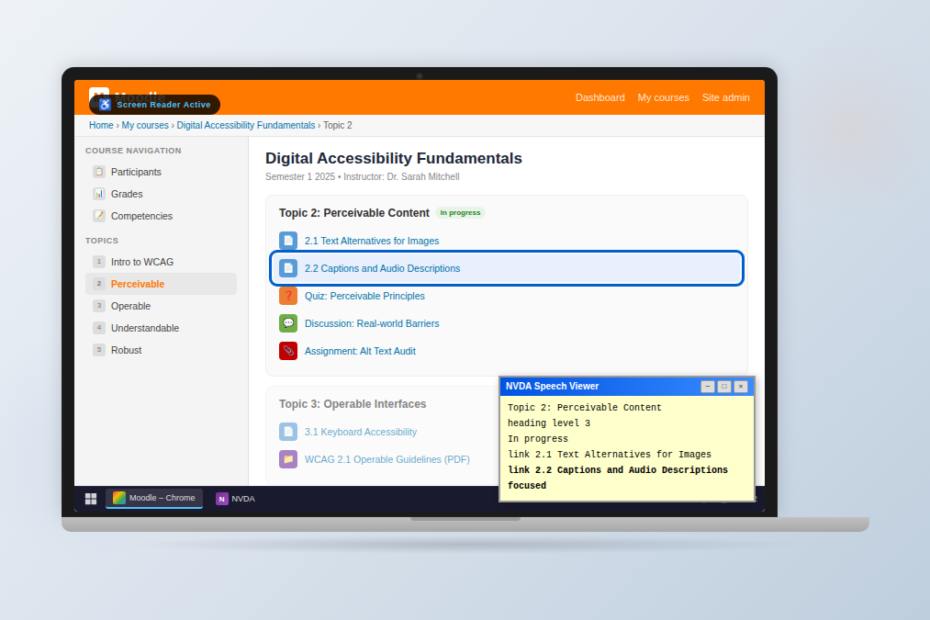
a laptop with a Moodle course ("Digital Accessibility Fundamentals") with the NVDA Speech Viewer open showing screen reader output, a blue focus ring on the current activity, and a Windows taskbar.

Why Accessibility Overlays Fail

  • 9 min read

Accessibility overlays promise a fast, low-cost path to compliance — but growing evidence from regulators, accessibility experts, and disability organisations shows they often fail to deliver. This article examines why overlays don’t fix underlying accessibility barriers, how they can interfere with assistive technologies, and why legal and regulatory bodies increasingly reject them as a compliance solution. More importantly, it outlines what genuine, sustainable digital accessibility actually requires.

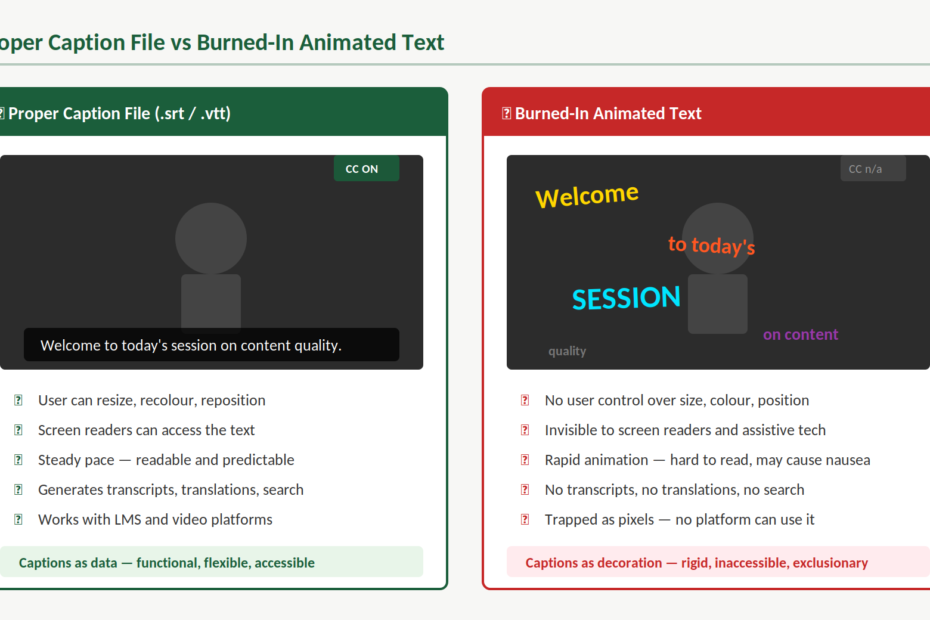
Side-by-side comparison of two approaches to video captions. On the left, labelled "Proper Caption File (.srt / .vtt)", a video player shows steady white caption text on a dark background reading "Welcome to today's session on content quality", with a CC ON button visible. Below it, five green ticks confirm: user can resize, recolour, and reposition; screen readers can access the text; steady pace that is readable and predictable; generates transcripts, translations, and search; works with LMS and video platforms. A summary reads "Captions as data — functional, flexible, accessible." On the right, labelled "Burned-In Animated Text", the same video shows words scattered across the frame in different sizes, colours, angles, and opacities, with no CC control available. Below it, five red crosses confirm: no user control over size, colour, or position; invisible to screen readers and assistive tech; rapid animation that is hard to read and may cause nausea; no transcripts, translations, or search; trapped as pixels with no platform able to use it. A summary reads "Captions as decoration — rigid, inaccessible, exclusionary."

When Captions Become Decoration: Why Animated Text Overlays Are an Accessibility Problem
  • 8 min read

Animated text overlays are everywhere — words bouncing, flashing, and flying across our screens in sync with speech. They look like captions, but they aren’t. When text is burned into a video instead of provided as a proper caption file, viewers lose control, assistive technologies lose access, and accessibility quietly disappears. This article explains why captions are infrastructure, not decoration — and how creators can keep their videos engaging without excluding the people who rely on captions most.

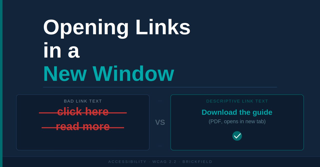
Opening Links in a New Window. It compares poor and good link text: the left example shows “click here” and “read more” crossed out as bad link text, while the right example shows the descriptive link “Download the guide (PDF, opens in new tab)” with a check mark indicating it is the recommended practice.

Opening Links in a New Window: Accessibility Guidance

  • 18 min read

Opening links in a new window or tab is rarely necessary and can create accessibility barriers for many users. For people using screen readers, magnification tools, or those unfamiliar with browser behaviour, unexpected new windows can disrupt navigation and cause confusion. This guidance explains why it is generally better to let links open in the same window, highlights what WCAG 2.2 recommends, and outlines the limited situations where opening a new window may be appropriate. It also provides practical tips for writing clearer, more descriptive links and improving overall accessibility.

115 years of IWD. International Women’s Day 2026. Brickfield Education Labs logo top right.

International Women’s Day  

  • 4 min read

This International Women’s Day, we’re reflecting on what it truly means to give — and what we all stand to gain.
The 2026 IWD theme, Give To Gain, feels right at home in a team built around learning. Knowledge grows when you share it. So does solidarity. We asked our team what the day means to them — here’s what they had to say.

a laptop with a Moodle course ("Digital Accessibility Fundamentals") with the NVDA Speech Viewer open showing screen reader output, a blue focus ring on the current activity, and a Windows taskbar.

Tips for Designing Moodle Courses That Work for Screen Reader Users (and Everyone Else)

  • 12 min read

Tips for Designing Moodle Courses That Work for Screen Reader Users (and Everyone Else). When you design for accessibility, you’re designing for better structure, clearer navigation, and less cognitive load. That helps everyone. We know from research that around 80% of people with learning needs don’t declare them — so you can’t wait for someone to ask. You need to design proactively.

11 February. International Day of Women and Girls in Science. Meet the women driving innovation at Brickfield Education Labs.

International Day of Women and Girls in Science

  • 8 min read

To mark International Day of Women and Girls in Science, we’re celebrating the women at Brickfield Education Labs who are shaping the future of technology. From product leadership to customer success and marketing, they share what inspired their careers in tech and their advice for the next generation of women considering a path in STEM.

University of Strathclyde

  • 4 min read
  • Region: United Kingdom
  • Sectors: Higher Education
  • Size: Approximately 30,000 students
  • Location:  Scotland
  • Tags: Rollout, Adoption, Remediation, Student, Training.